

Artificial intelligence is transforming the global workforce, but in 2026 the biggest shift isn’t just AI replacing jobs-it’s AI blending with traditional careers. Across India’s tech sector, companies are actively hiring professionals who combine AI expertise with domain-specific knowledge such as software engineering, cybersecurity, finance, healthcare, and product management.
These emerging roles are commonly called hybrid AI jobs. Instead of pure AI researchers, organizations now want professionals who understand both AI tools and real-world applications. This demand is growing rapidly as businesses integrate machine learning, automation, and data-driven decision-making into everyday operations.
This article explains who hybrid AI professionals are, the skills Indian tech workers need in 2026, common job roles, salary expectations, and certifications that help build a career in this fast-growing field.
What Are Hybrid AI Jobs?
Hybrid AI jobs combine artificial intelligence skills with expertise in another professional domain. These roles require individuals who can apply AI tools to real-world business or technical problems.
For example:
- A software developer who integrates AI models into applications
- A cybersecurity analyst who uses machine learning to detect threats
- A financial analyst who uses AI for predictive market insights
Rather than focusing only on building algorithms, hybrid professionals focus on implementing AI to solve industry-specific challenges.
Why Companies Prefer Hybrid Professionals
Businesses are moving away from hiring purely academic AI specialists because:
- They need practical AI implementation, not just research
- AI systems must integrate with existing software infrastructure
- Domain knowledge helps ensure models deliver real business value
This is why hybrid AI jobs are becoming one of the most in-demand career paths in India’s tech sector.
Why Hybrid AI Jobs Are Growing in India
Several factors are driving demand for hybrid AI professionals across India.
Rapid AI Adoption
Indian companies are investing heavily in AI tools for:
- customer support automation
- predictive analytics
- fraud detection
- marketing optimization
- supply chain forecasting
However, implementing these systems requires professionals who understand both AI and the business context.
Expansion of India’s Tech Industry
India has one of the world’s largest technology workforces, with major IT service companies and startups building AI-driven products.
Large companies such as Tata Consultancy Services, Infosys, and Wipro are integrating AI into enterprise solutions. These firms increasingly require engineers who can combine traditional development skills with AI capabilities.
Rise of AI-Powered Startups
India’s startup ecosystem is also accelerating demand for hybrid professionals. AI startups require engineers who can handle:
- backend development
- machine learning pipelines
- data engineering
- product integration
This multi-skill requirement is exactly what defines hybrid AI jobs.
Who Are Hybrid AI Professionals?
Hybrid professionals combine AI knowledge with expertise in another field.
Instead of specializing in a single discipline, they develop cross-functional skills that bridge technology and industry applications.
Examples of Hybrid AI Professionals
AI Software Engineer
A developer who integrates machine learning models into applications and production systems.
AI Product Manager
A product leader who understands AI capabilities and guides development of AI-powered products.
AI Cybersecurity Analyst
A security specialist who uses machine learning models to detect anomalies and cyber threats.
AI Data Analyst
A professional who uses AI tools to automate data insights and predictive analysis.
AI Cloud Engineer
An engineer who deploys AI workloads using cloud platforms.
These roles require professionals to be comfortable with both AI tools and domain-specific workflows.
Most In-Demand Hybrid AI Jobs in India (2026)
Several hybrid AI roles are gaining popularity across India’s technology sector.
1. AI Software Engineer
AI software engineers build applications that integrate machine learning capabilities.
Typical responsibilities include:
- integrating AI APIs into software
- deploying machine learning models
- building intelligent applications
Average salary (India):
₹12–30 lakh per year depending on experience.
2. AI Data Engineer
Data engineers manage pipelines that feed data into machine learning systems.
Key tasks include:
- building data pipelines
- managing large datasets
- optimizing data processing systems
Average salary:
₹10–28 lakh per year.
3. AI Product Manager
AI product managers guide development of AI-based software solutions.
Responsibilities include:
- defining AI product strategies
- coordinating engineering teams
- translating business needs into technical requirements
Average salary:
₹18–40 lakh per year.
4. AI Cybersecurity Specialist
Cybersecurity professionals are increasingly using AI to detect threats automatically.
Responsibilities include:
- anomaly detection using machine learning
- automated security monitoring
- threat intelligence analysis
Average salary:
₹15–35 lakh per year.
5. AI Cloud Engineer
These professionals deploy AI models on cloud platforms and manage infrastructure.
Responsibilities include:
- cloud AI pipelines
- model deployment and scaling
- infrastructure automation
Average salary:
₹12–32 lakh per year.
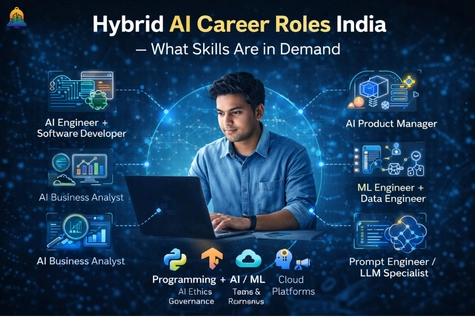
Skill Roadmap for Hybrid AI Jobs in 2026
To succeed in hybrid AI jobs, Indian tech professionals need a combination of technical and domain-specific skills.
1. Programming Skills
Programming remains the foundation for AI development.
Key languages include:
- Python
- Java
- JavaScript
- SQL
Python is particularly important because many AI frameworks are built around it.
2. Machine Learning Knowledge
Hybrid professionals should understand the basics of machine learning such as:
- supervised learning
- neural networks
- natural language processing
- model evaluation
Knowledge of frameworks like TensorFlow and PyTorch is highly valuable.
3. Data Analysis Skills
AI systems depend heavily on data, making data skills essential.
Professionals should understand:
- data visualization
- statistical analysis
- data cleaning and preprocessing
- SQL and big data tools
4. Cloud Computing
Many AI systems run on cloud platforms.
Popular cloud platforms include:
- Amazon Web Services
- Microsoft Azure
- Google Cloud
Understanding how to deploy AI models on these platforms is a key skill for hybrid AI professionals.
5. Domain Expertise
Hybrid AI jobs require knowledge beyond technology.
Examples include:
- finance knowledge for fintech AI
- healthcare data for medical AI
- cybersecurity practices for security AI
Domain expertise helps professionals apply AI effectively in real-world contexts.
Certifications That Help Build Hybrid AI Careers
Certifications can help professionals validate their skills and improve job prospects.
Popular certifications include:
AI and Machine Learning Certifications
- Google Professional Machine Learning Engineer
- AWS Machine Learning Specialty
- Microsoft Azure AI Engineer
Cloud Certifications
- AWS Certified Solutions Architect
- Google Cloud Professional Cloud Architect
- Microsoft Azure Administrator
Data Certifications
- Certified Data Scientist
- Data Analytics Professional certifications
These certifications demonstrate both technical competence and practical skills.
How Indian Professionals Can Transition Into Hybrid AI Roles
Many professionals already working in traditional tech roles can transition into hybrid AI careers.
Step 1: Learn AI Fundamentals
Start with courses on machine learning, neural networks, and AI tools.
Step 2: Practice With Real Projects
Building practical projects helps demonstrate AI skills.
Examples include:
- chatbot applications
- recommendation systems
- fraud detection models
Step 3: Combine With Existing Skills
Software engineers, analysts, and cybersecurity professionals should integrate AI into their existing domain expertise.
Step 4: Build a Portfolio
Showcasing AI projects on GitHub or personal websites improves visibility to recruiters.
Future Outlook for Hybrid AI Jobs in India
Hybrid AI jobs are expected to grow significantly over the next decade.
Key trends include:
- increased AI adoption across industries
- demand for AI-powered automation
- growth of AI-enabled enterprise software
As organizations move from experimentation to large-scale AI deployment, professionals who understand both AI and industry workflows will be the most valuable.
This makes hybrid AI careers one of the most promising technology career paths for Indian professionals in 2026 and beyond.
Conclusion
The rise of hybrid AI jobs reflects a fundamental shift in how companies use artificial intelligence. Instead of hiring isolated AI researchers, businesses now need professionals who can combine AI expertise with real-world technical or industry knowledge.
In India’s rapidly expanding tech sector, hybrid AI roles such as AI software engineers, AI data engineers, and AI product managers are becoming highly sought-after careers. By building skills in programming, machine learning, cloud computing, and domain expertise, professionals can position themselves for success in this evolving job market.
For Indian tech workers planning their future careers, developing hybrid AI skills is one of the smartest strategies for staying competitive in the AI-driven economy
Stay updated with Your City Bulletin